
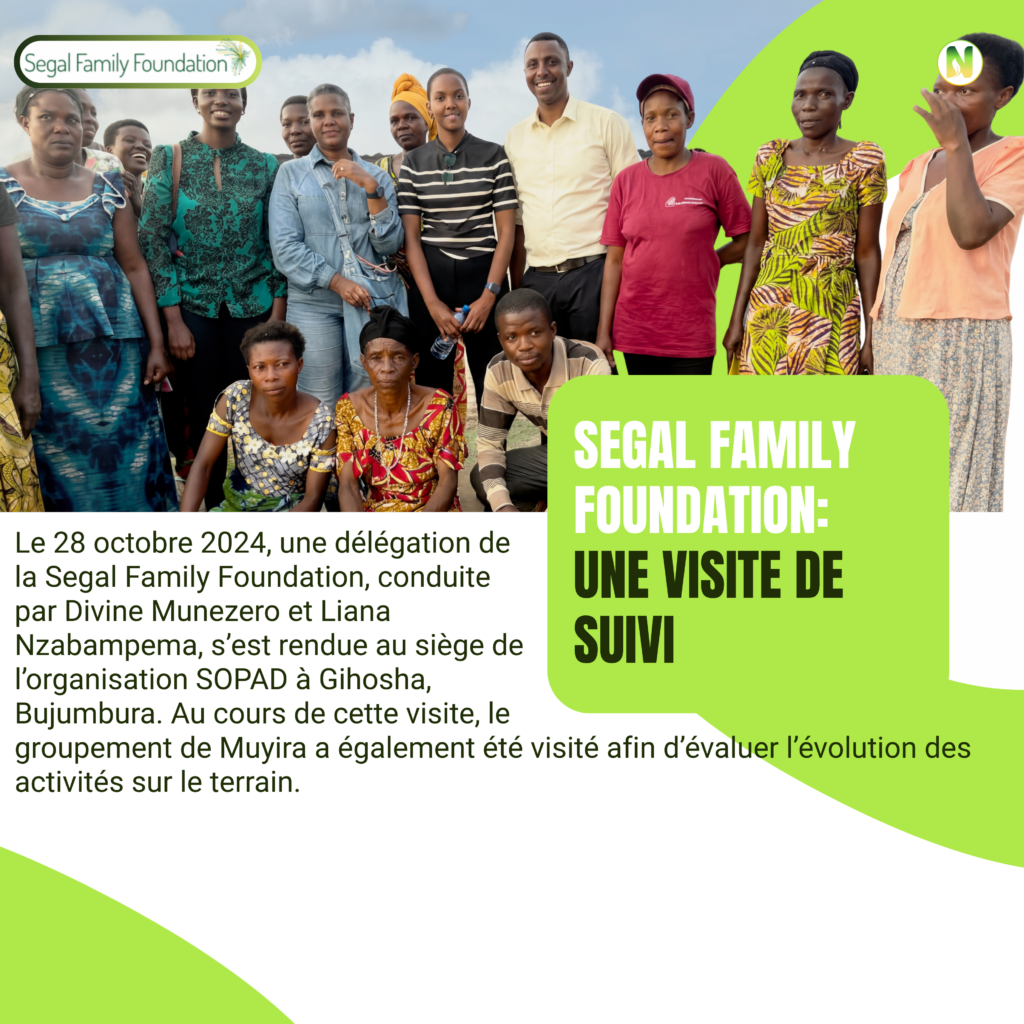
On October 28, 2024, a delegation from the Segal Family Foundation, led by Divine Munezero and Liana Nzabampema, visited the headquarters of the SOPAD organization in Gihosha, Bujumbura. During the visit, the delegation also visited the Muyira group to assess the progress of activities on the ground.
After a warm welcome at the organization’s headquarters, the discussions focused on SOPAD’s achievements, the challenges it has faced, and opportunities for improvement to ensure the sustainability of its initiatives. The project’s impact on the local community was at the heart of the discussions, particularly with regard to the number of people who have benefited directly or indirectly from the initiatives implemented.
In rural Bujumbura, three groups, with a total of 60 members, are benefiting from the project’s activities, thereby reaching 280 people through the demonstration fields in Buzige, Coga, and Muyira. In Rumonge, a group of 15 members was formed, enabling 100 beneficiaries to benefit from the crops grown on the Gahuni-Gitaza demonstration field. In Bubanza Province, two groups comprising 28 women support 157 beneficiaries, notably through agricultural projects established in Buringa and Gihanga. Finally, in Muramvya, a community of 14 households—more than 129 people—is benefiting from the agricultural and economic activities implemented in the region.
The delegation also reviewed the strategies put in place to promote the empowerment of beneficiaries and the optimal use of available resources. These approaches include innovative models such as the 50%-50% and 80%-20% models, as well as the “10 plants, one household” program, which aim to strengthen the economic resilience of local communities by promoting an equitable distribution of resources and the active participation of beneficiaries.
This visit was part of the monitoring and evaluation of initiatives supported by the Segal Family Foundation, with the goal of analyzing the impact of the projects implemented by SOPAD and identifying opportunities for improvement in order to maximize the benefits for local communities.
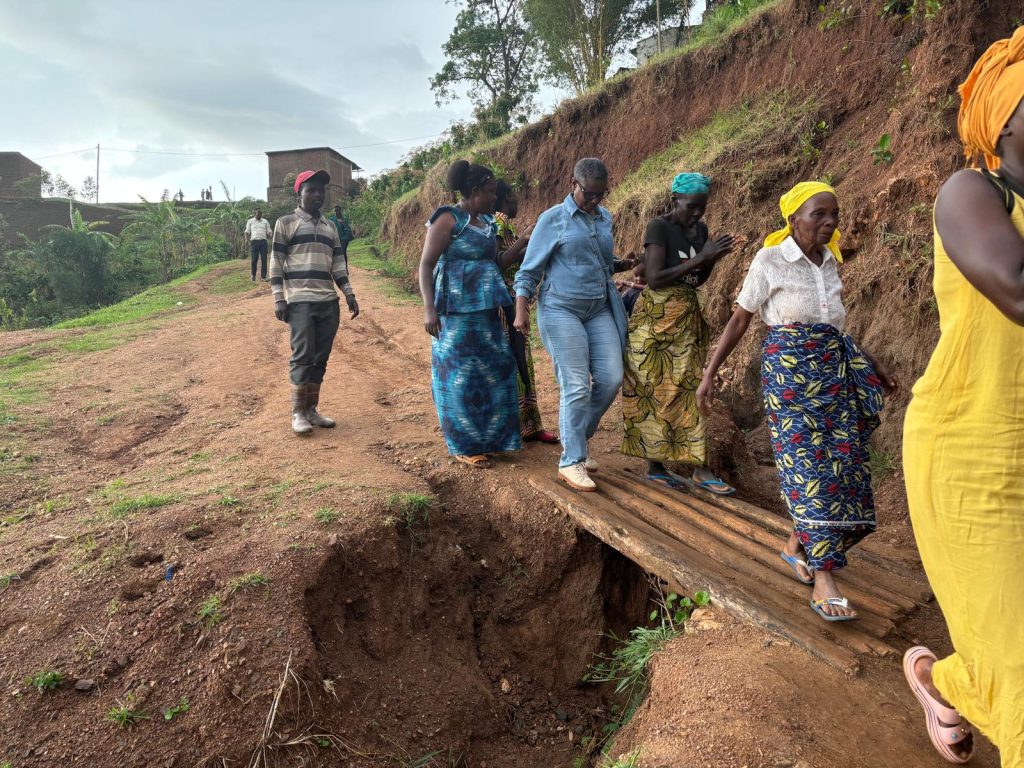
Following this visit, the delegation traveled to the field—specifically to the Muyira cooperative—to observe firsthand the progress of the agricultural and economic activities implemented by the beneficiaries. This on-site visit provided an opportunity to assess the progress made, engage directly with the cooperative’s members, and gather their firsthand accounts of the project’s tangible impact on their daily lives.
Many members have expressed a desire to have, on an individual basis, a field equivalent to the model field established by SOPAD. Thanks to this initiative, more than 30 hectares of passion fruit will be cultivated, thereby ensuring increased production and a sufficient supply of raw materials for processing and marketing activities.
At the end of the day, representatives from the Segal Family Foundation praised the efforts made by SOPAD and its partners to improve the living conditions of local communities.
When asked about the challenges and difficulties encountered in implementing the project, the SOPAD representative noted that SOPATRAM recently launched a new industrial facility, which requires significant quantities of raw materials as well as skilled personnel to ensure its smooth operation. In light of these challenges, she stressed the need for increased support to stabilize the supply chain and ensure sufficient working capital to optimize the operation of the new production facility.