

When we speak of the “Abatwa,” we are referring to a distinct community for whom—it seems—the country’s laws and regulations are made for some but not for others. For decades, this group of people has been unable to defend its interests, and its very existence continues to be disregarded, while the world around them carries on at its own pace. To help them succeed, the COPAD cooperative supports 14 women from this community in economic development activities in the Kiganda commune of Muramvya province.
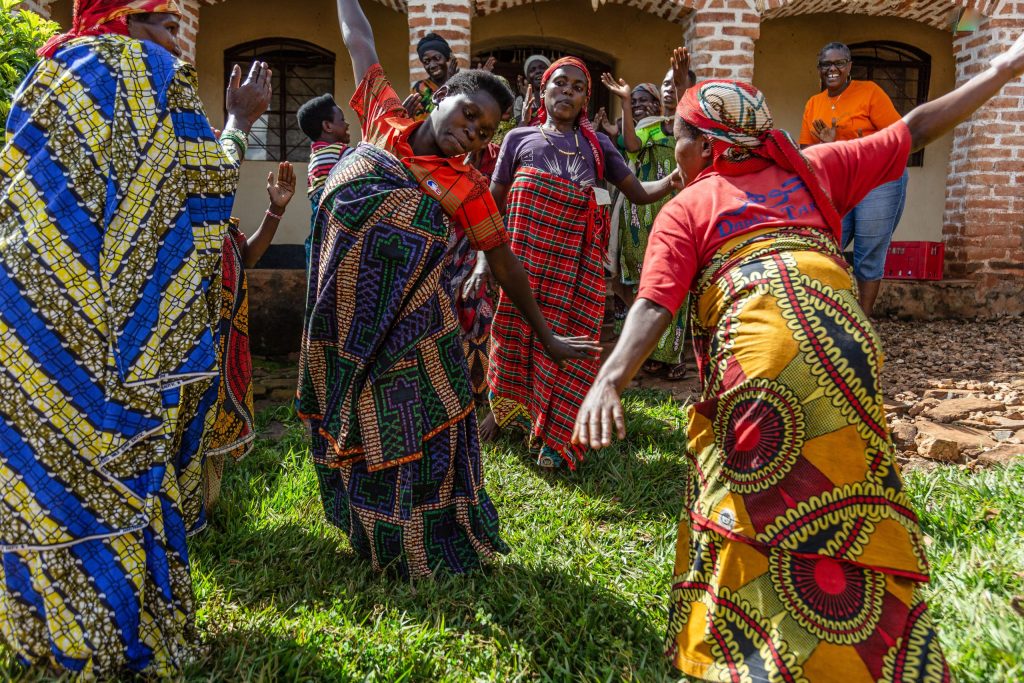
It is 9:30 a.m. It’s Friday. The sun’s rays are not as strong where a group of young women from the Batwa community in Kiganda Township are humming joyful songs to the rhythm of a traditional dance as they await the launch of the COPAD Cooperative’s farming activities. Leading the group, Ms. Bénigne Kigeme first expresses her joy before sharing their expectations for the cooperative, which include unity and an opportunity to prove themselves to neighboring villagers who, in a corner, used to mock them with harsh words “Ntamuntu asangira nabatwa aba ari igicibwa”—literally, “one is cursed when sitting with the Batwa”—implying that they are not descendants of Homo sapiens. One way or another, the 14 women in question didn’t care—as if they’d grown accustomed to putting up with such insults.
Despite everything, nothing in the world could deter the Batwa women of the Kiganda commune from pursuing their vision and their determination to form a cooperative. Their primary goal is to make themselves known at the communal level so they can operate formally. In addition to this need, they want to acquire work equipment so that, when they are not engaged in cooperative activities, they can go work in people’s fields and earn money. They also want to set up a savings fund to plan for their future and to finance their microprojects, with goat and pig farming being their top priorities.
A whole chain of beneficiaries
Judging by the atmosphere and the joy evident on these young women’s faces, it’s clear that they really needed a catalyst to get this project off the ground—a project they had been waiting for for months. We can conclude that they were hoping to earn an income from it and that this, in fact, was the reason they came together.
Yolande Buganayandi, a female member of the team, says:“We don’t have any land; we live in extreme poverty. We welcome COPAD for coming to give us a helping hand. From now on, we’ll be able to earn money and send our children to school. Plus, our families will be able to eat their fill.” She added,“COPAD will also allow us to have small livestock so we can be respected in society. Our husbands will no longer have to struggle on their own to provide for their families.”
It’s not just women who benefit; rather, there’s a whole chain of beneficiaries, all the way to the end consumer of agricultural products who enjoys their flavor.
From plowing to planting, from weeding to harvesting, a whole chain of overlapping activities enables women to earn their daily bread. For tasks that require physical strength, such as uprooting tree stumps, the women participating in the project rely on their husbands for support.
Local officials are also pleased with this development project aimed at vulnerable people and those marginalized by society, according to a local council member.
A whole host of challenges overcome
The Batwa women of Kiganda have no arable land. They make their living primarily by working as laborers for farmers; when there is no work available, they spend their time on the streets or in the town centers begging for something to eat. The COPAD cooperative farms an area of approximately 3.5 hectares, where it grows food crops such as corn, beans, potatoes, hibiscus, and passion fruit. According to Ms. Claudette Nduwayezu, the pioneer of this initiative, part of the harvest—equivalent to one hectare—will be used to feed the families of the women beneficiaries, while another portion will be sold to ensure the project’s sustainability.
In addition to a share of the harvest, the women beneficiaries are paid a daily wage for all farm work. The average daily wage for a woman is 2,500 Fbu, while it is 3,000 Fbu for a man. This means that, on average, a woman can earn 300,000 Fbu per season—enough to buy livestock or equivalent to the average income of a civil servant with a bachelor’s degree.
COPAD has implemented a meal program for its beneficiaries—and often their children—on workdays to spare them the worry of preparing meals. This is truly gratifying for these women, as Triphonie Ngendakumana, one of the group’s members, points out. The program was also launched to combat the severe malnutrition that was rampant among the children in this community, rather than resorting to beliefs in fetishes and witches’ brooms—as has always been the case when a sudden death occurs.
Editorial Department, ID
